
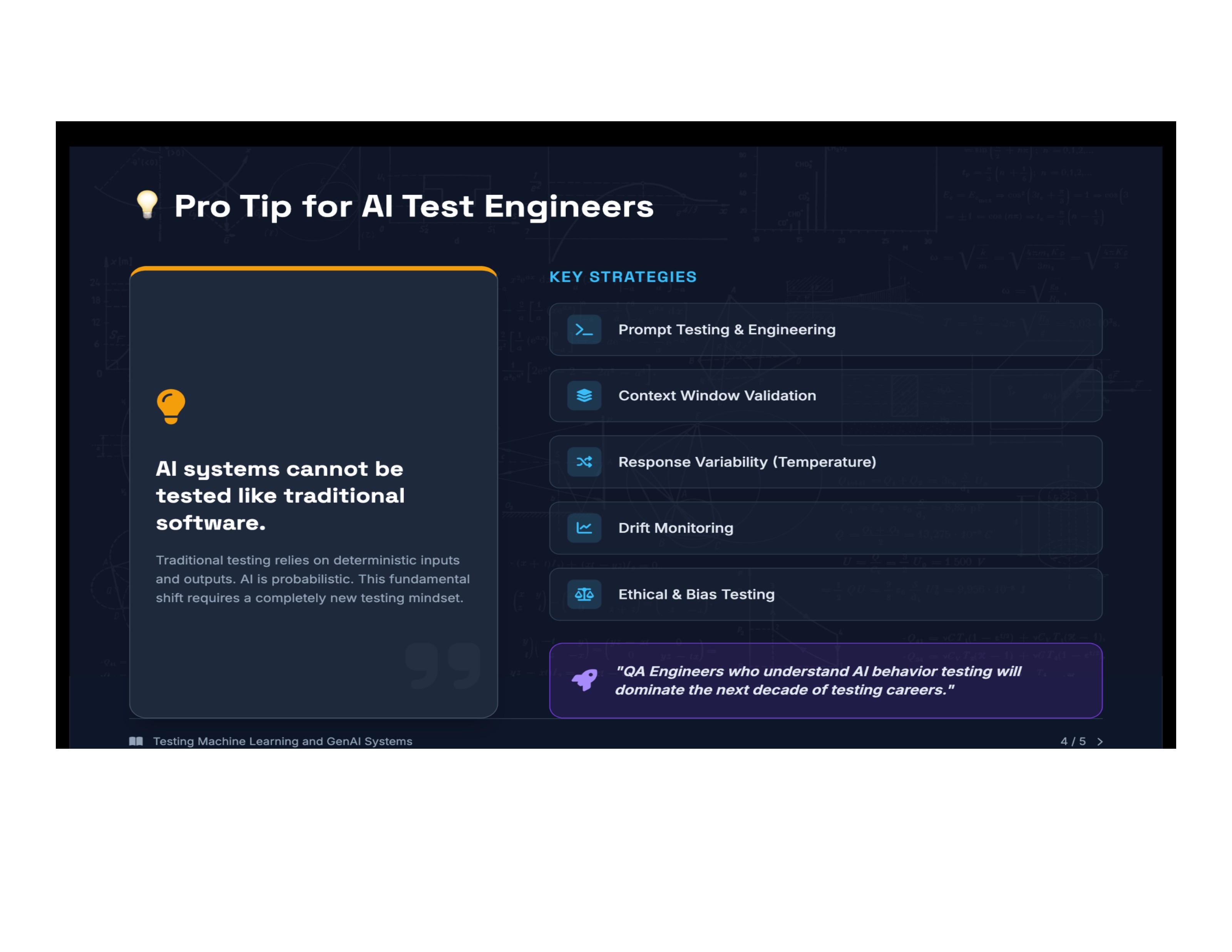
AI systems cannot be tested like traditional software. Traditional testing relies on deterministic inputs and outputs — AI is probabilistic. This fundamental shift requires a completely new testing mindset. Two topics keep coming up in real AI QA interviews: Temperature Testing in LLMs and RAG architecture validation.
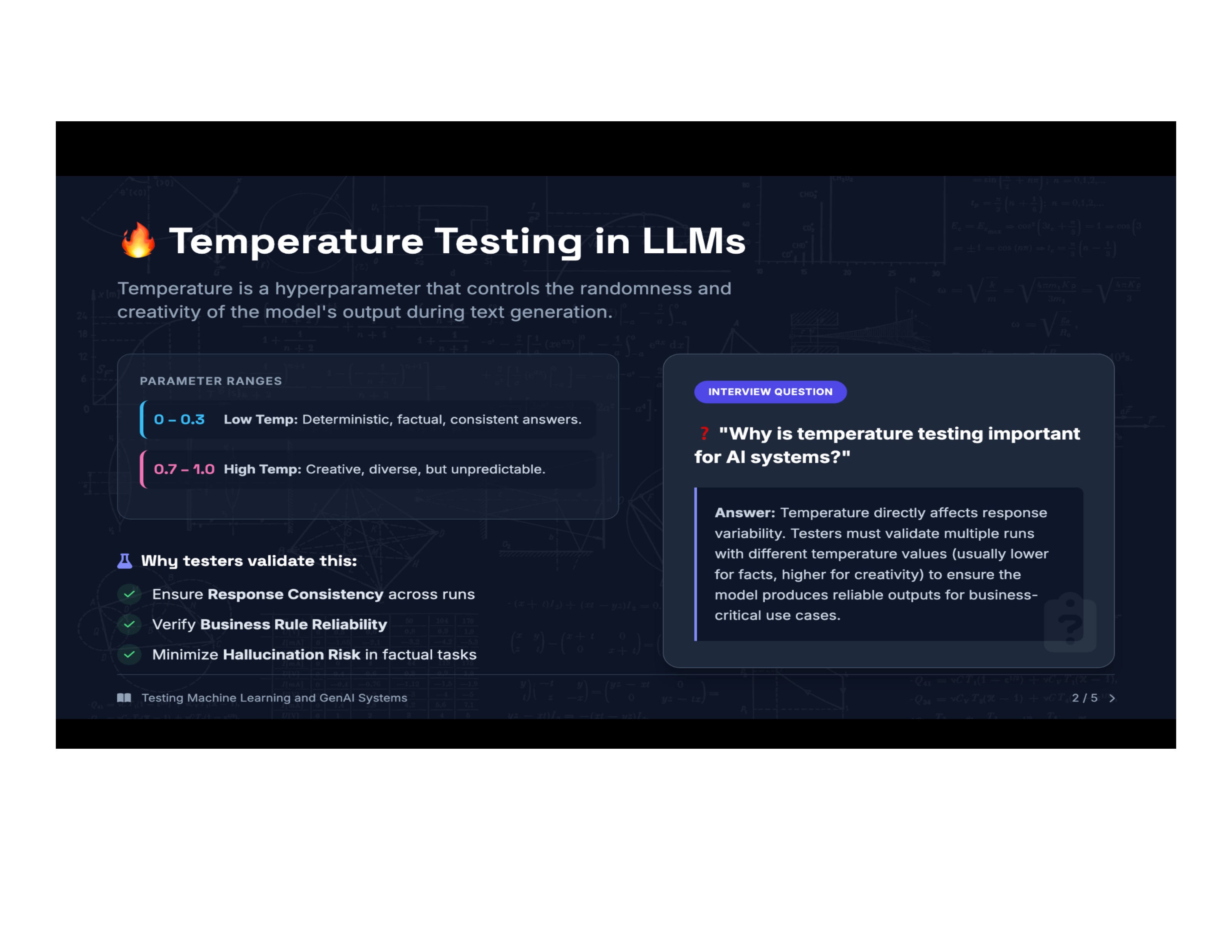
🔥 Temperature Testing in LLMs
Temperature is a hyperparameter that controls the randomness and creativity of the model's output during text generation.
0 – 0.3 Low Temp
Deterministic, factual, consistent answers. Use this for business-critical flows where facts and formats must not drift.
0.7 – 1.0 High Temp
Creative, diverse, but unpredictable output. Great for brainstorming, risky for factual tasks.
Response Consistency
Validate multiple runs at the same temperature to confirm the model stays on-message.
Business Rule Reliability
Lock low-temperature runs behind critical flows where compliance and precision matter.
Hallucination Risk
Track factual accuracy across temperatures to define the safe ceiling for each use case.
❓ Interview Question: Temperature
"Why is temperature testing important for AI systems?" Temperature directly affects response variability. Testers must validate multiple runs with different temperature values — usually lower for facts, higher for creativity — to ensure the model produces reliable outputs for business-critical use cases.
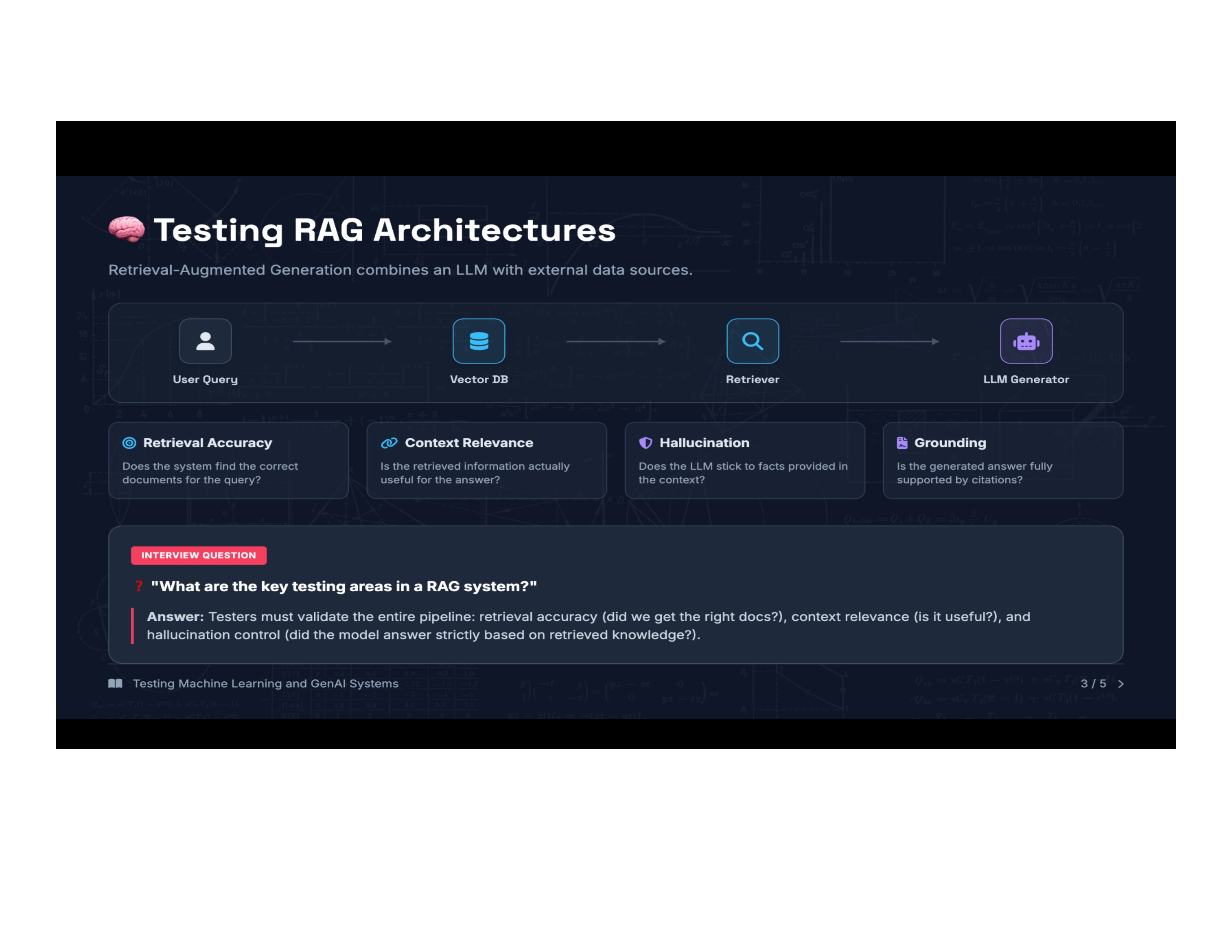
🧠 Testing RAG Architectures
Retrieval-Augmented Generation combines an LLM with external data sources. The pipeline is simple: User Query → Vector DB → Retriever → LLM Generator. But testing must cover the whole pipeline, not just the final output.
Retrieval Accuracy
Does the system find the correct documents for the query?
Context Relevance
Is the retrieved information actually useful for the answer?
Hallucination
Does the LLM stick to facts provided in the context instead of making things up?
Grounding
Is the generated answer fully supported by citations and retrieved evidence?
❓ Interview Question: RAG
"What are the key testing areas in a RAG system?" Testers must validate the entire pipeline: retrieval accuracy (did we get the right docs?), context relevance (is it useful?), and hallucination control (did the model answer strictly based on retrieved knowledge?).
💡 Key Strategies for AI Test Engineers
Prompt Testing & Engineering
Version prompts and treat them like code — with regression suites.
Context Window Validation
Confirm the model behaves correctly at the edge of its context budget.
Response Variability (Temperature)
Sweep temperature and sampling parameters to map the response envelope.
Drift Monitoring
Detect quality decay as models, prompts, or data sources change under you.
Ethical & Bias Testing
Probe for fairness, harmful outputs, and demographic skew before shipping.
From the pages
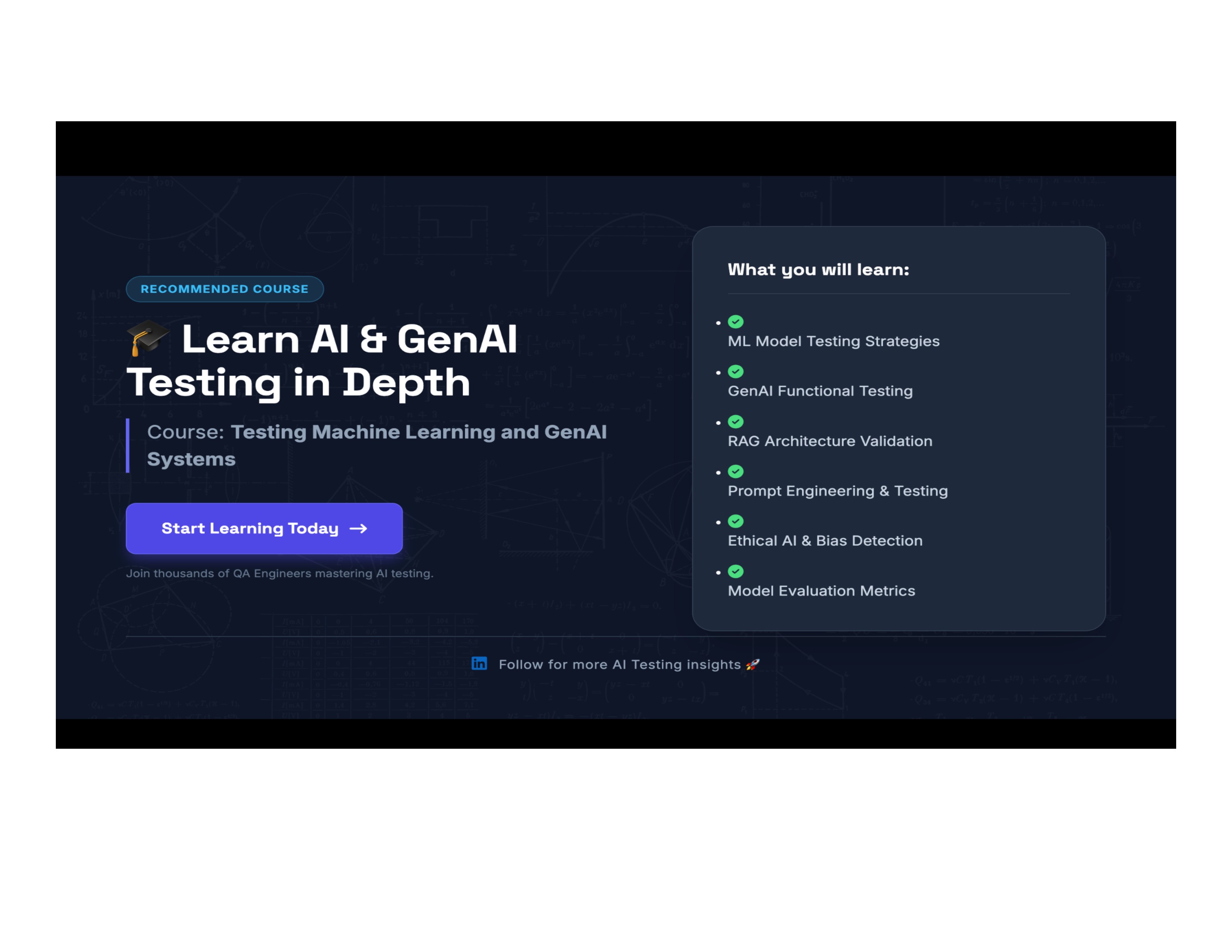
QA Engineers who understand AI behavior testing will dominate the next decade of testing careers.
Go deeper
Want to master this? Check out my full course on Agentic AI for QA Automation with Python with an exclusive discount.